

Greece Taxi Tours & Transfers - Private Tours in/from Athens /Multiple Day Tours in Greece
Greece Taxi Tours Info Tel:+30 210 9768557(8.00AM -22.00PM)+30 698 6688 996 greecetaxi@greecetaxi.gr

Meteora Rocks & Monasteries
Meteora private tour.
Meteora private tour. Visit Meteora orthodox monasteries and Meteora rocks, the rocky forest of Greece... Best top destination tour. Greece taxi minivan service


Greece taxi visits Meteora & the orthodox monasteries. Greece Minivan Taxi Service
64 gigantic rocks rise perpendicularly from the ground on the western edge of the plain of Thessaly in the heart of northern Greece. These ancient pinnacles etched by wind and rain echoed the chants of the ascetic community of Meteora, home of monks who live in monasteries and chapels perched precariously upon the rocks. Meteora stands on the plain of Thessaly beside the village of Kastraki around 26 km (16 m) north of Trikala and 375 km (234 m) northwest of Athens. The grey monolithic rocks stand in front of the Pindos Mountains. View our virtual tour http://www.youtube.com/watch?v=CQZMTbKsAwI
The conglomerate was formed of deposits of stone, sand and mud from streams flowing into a delta at the edge of a lake, over millions of years. About 60 million years ago during the Paleogene Period a series of earth movements pushed the seabed upwards, creating a high plateau and causing many vertical fault lines in the thick layer of sandstone. The huge rock pillars were then formed by weathering by water, wind and extremes of temperature on the vertical faults. It is unusual that this conglomerate formation and type of weathering are confined to a relatively localized area within the surrounding mountain formation.


We visit Meteora, the rocky forest of Greece


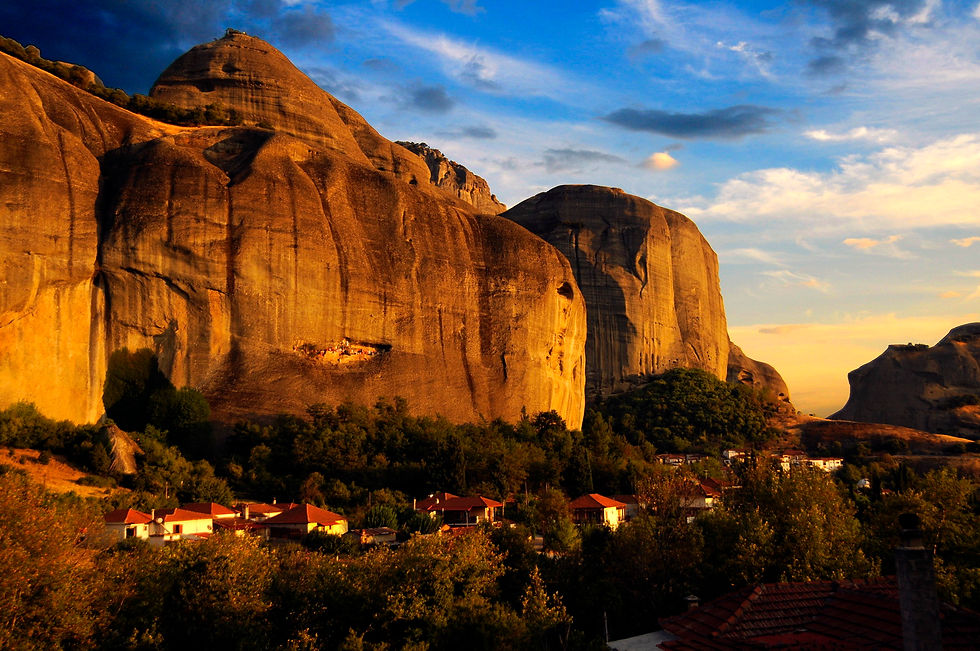


The impressive rocks are composed of a mixture of sandstone and hard gravel called conglomerate. Formed 60 million years ago as the bed of sea, which we now know, as the plain of Thessaly. Seismic movements thrust the sea bed upwards to create a high plateau and split the thick layer of sandstone into innumerable faults. Wind, water and extreme temperatures wore away the fractured sandstone creating the pillars, which are now known as “the rocky forest of Greece”.
As early as the 11th century, monks occupied the caverns of Meteora. However, monasteries were not built until the 14th century, when the monks sought somewhere to hide in the face of an increasing number of Turkish attacks on Greece. At this time, access to the top was via removable ladders or windlass. Nowadays, getting up is a lot simpler due to steps being carved into the rock during the 1922. Of the 24 monasteries, only 6 (four male, two female) are still functioning, with each housing about 15 individuals

Meteora Rocks & Monasteries as a destination is on the top list. We tried to include it and combine it with the most popular tours. A list is below

Visit Monasteries in a three day tour, Is our shortest tour combined with Delphi for travelers with limit time

We combine Meteora in a Pelion Tour, more...

We combine Meteora in a Classical tour of Greece, more...

We combine Meteora in a Macedonia tour, more...

View all our Private tours which include Meteora destination, more...

Visit Meteora Rocks and the Orthodox Monasteries, more...
We specialize in creating the private personal tours of your lifetime (Ancient, Classical, Historical, Biblical tours...in Greece) where you can relax, have no worry of driving, allowing all passengers to enjoy the scenic drives through the beautiful Greek countryside (Athens, Sparta, Nafplion, Olympia, Monemvasia, Delphi, Meteora, Vicos Gorge, Mount Olympus, Mount Pelion, Macedonia, Aegae, Pella, Thessaloniki ...) stopping wherever you desire to take photos, swim, hiking, have a break...a tour at your leisure. Greece Taxi & Minivan Service

We visit Meteora & Monasteries all year around. We combine it in a long tour "Visit Greece'. A unique tour which include most of Greece

We combine Meteora in a Apostle Paul Route private Tour, more...
Meteora -this city of Monastic Life of Rocks stands as the most important and the largest centre of Orthodox Monasticism in Greece, after Mt. Athos. This stone forest of rocks constitutes one of the most wonderful and impressive geological phenomena on our planet. The most common theory holds the view, that the formation of the rocks was due to the prior existence of a delta shaped cone comprising of river stones and mud, which poured into the ancient Thessaly basin. After the geological separation of the masses of Olympus as well as Ossa, the waters of the basin found an outlet into the Aegean through the Tempi area. Then the delta shaped mass (by the effect of earthquakes, wind and rain for millions of years) broke-up into stones and huge solid rocks up to 400 meters high.

We visit Meteora & See the Other Greece
Of the 24 monasteries that grew up between the 14th and 16th centuries only six are still inhabited:The Great Meteoron, Agia Triada, Agios Nikolaos and Varlaam by monks: Agios Stephanos and Roussanou (St. Barbara) by nuns. Meteora has been recognized as a protected Monument for Humanity by UNESCO and other international Organizations and that it must be maintained as such for bearing witness to Christian, historical, architectural, agiographic ( and generally artistic) and geological evidence. The area of Meteora, since October 1995 by civil law( 2531/11.10.95) and in following relative decision by the Synod of the Church of Greece in 1990- was declared: holy ground, unchangeable and an violated, a fact, which secures its Orthodox authenticity and effective protection. View our virtual tour http://www.youtube.com/watch?v=CQZMTbKsAwI


We visit Meteora all year around


Why Greece taxi: Because, we visit Meteora Rocks & Orthodox Monasteries as travelers, we get as excited as you, we love touring & photography...We love what we do...:) Although we have greatly enjoyed traveling around Greece, checking out places, taking photos and writing our text, as we are sure you can appreciate, it was at great expense and also time consuming. We continue to develop the site updating and adding new information constantly. Therefore we kindly ask any interested party who wishes to copy any part of the site - text or photos - to contact us and make a proposal before doing so. Thank you for your co-operation.


Visit the Monasteries: Agios Nikolaos daily, summer 9.00a.m to 16.00 p.m (Closed on Fridays) Poussanou daily except Wednesdays, summer 9.00a.m to 17.00p.m - (Winter to 14.00.pm ) Entrance fee 3 Euro. Megalo Meteoron daily except Tuesdays 9a.m t0 17.00 p.m (15.00 p.m in winter closed Tuesdays & Wednesdays) entrance fee 3 Euro. Varlaam daily except Fridays (and Thursdays in winter), same times as for the Megalo Meteoro. Agia Triada daily except Thursdays 9.00a.m to 12.30p.m and 3p.m to 17.00p.m (winter 16.00pm. closed Wednesdays & Thursdays) Entrance fee 3 Euro Agios Stefanos daily except Mondays 9.00a.m to 13.00 p.m and 15.00 to 18.00. (16.00 p.m in winter). Greece Taxi & Minivan Service.
