

Greece Taxi Tours & Transfers - Private Tours in/from Athens /Multiple Day Tours in Greece
Greece Taxi Tours Info Tel:+30 210 9768557(8.00AM -22.00PM)+30 698 6688 996 greecetaxi@greecetaxi.gr

We Visit
Mycenae Acropolis
Mycenae Tour, Agamemnon Palace... The Lions Gate, Atreus & Clytemnestra Tombs... visit the Homeric city, with the hidden history, mythology... Greece Taxi Minivan Service


Visit Mycenae Acropolis, Agamemnon Palace & Atreas Tomb


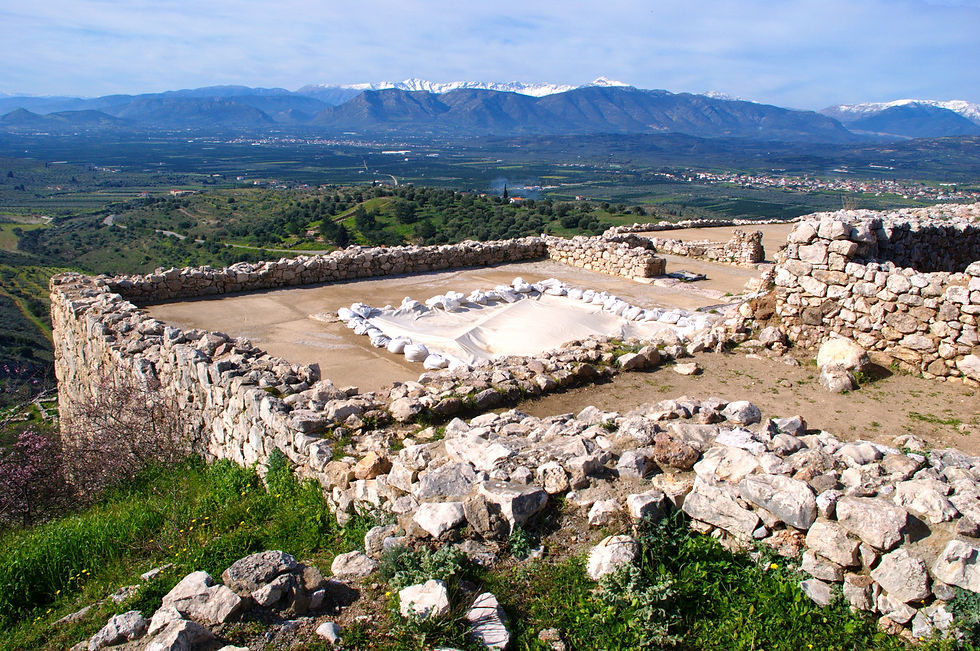
MYCENAE ACROPOLIS - PANORAMIC VIEW
Greece in the bronze age, had several important centers, including Mycenae. Mycenae, city of Agamemnon, was one of several heavily fortified strongholds. The king lived in a place with many rooms which served as a military headquarters and a centre of administration for the surrounding countryside. The Mycenaean's were warriors, and weapons and armor have been found in their graves. They were also great traders and sailed far and wide. Their civilization reached the height of its power in about 1600 b.c and eclipsed the Minoan civilization of Crete. All seemed secure and prosperous, but around 1300 b.c the Mycenaean's started to build huge defensive walls around all the major towns. The Mycenaean world was under threat from foreign invaders. By about 1200 bc. the cities began to be abandoned or destroyed. View our virtual tour http://www.youtube.com/watch?v=4MAi2X2gZpE


Mycenae is the region’s most famous site, its name linked with some of the most memorable myths of Greek epic poetry and tragedy. Of particular significance is its location–on a steep hill within sight of the fertile plain of Argos and the gulf of Nafplion, protected at the rear by two mountains and deep valleys. This is a typical choice for the settlement site of a wayfaring community. The main entrance to the citable of Mycenae was a monumental gateway in the walls, wide enough for carts to pass through. The two lions decorating the famous gate to which they give their name. Encircling the acropolis are two rings of walls, the first built in the 14th century B.C. using the cyclopean technique of large, irregular blocks. The second, larger, ring of walls of the 13th century was built of more regular blocks.
They were only two entry points: The first was the Lion Gate (in fact they are probably two lionesses). The Lion Gate is now virtually a symbol of the land and its past and is one of many examples of the skills of Mycenaean architects. The second was the Postern Gate. This postern provided access along the northeast stretch of the walls, towards the mountain, it was clearly visible to the inhabitants but practically imperceptible to anyone approaching from outside.


Bronze danger decorated with gold, 16th century. B.C. Found in Tomb IV, Royal Grave Circle A, Mycenae




Visitors to the site climb a ramp leading across the cemetery where huge mounds conceal “tholos” tombs (many of them still accessible), which have been attributed – with great leaps of the imagination – to figures from Homer’s epic tale: Atreus, Clytemnestra and Aegisthus. The so-called “Treasury of Atreus” is a typical, imposing Mycenaean “tholos” tomb. Its approach is a "dromo" 36 m (118 ft ) long and 6 m (20 ft) wide, open to the sky and flanked by sloping walls of enormous blocks of stone arranged in regular rows.
The interior of the Treasury of Atreus is built of beautifully regular courses of blocks, each projecting slightly beyond the one below to form the corbelled vault. From a technical and ideological point of view, the “tholos” tombs are one of the most interesting Mycenaean architectural developments. Stylistically, they can perhaps be seen as standing at an intersection between the long tradition of European (and Indo-European) megalithic structures and the tectonic gigantism of Near Eastern and Egyptian architecture.

Mycenaean Mythology: According to the tradition Mycenae was founded by Perseus, the son of Zeus and Danae. Tradition relates that Perseus founded Mycenae and used the mythical giants, the Cyclops (giant builders who had but one eye in the middle of their forehead) to built its mighty walls, which are therefore called "cyclopean". The same giants had already built the walls of Tiryns (10 miles away). The last member of the Perseid dynasty was Eurystheus, the king who set his cousin Heracles the famous labors. After the death of Heracles, Eurystheus pursued his descendants into Attica, and there was killed by Lolaus. The Mycenaeans, obeying the Delphic Oracle, summoned Atreus and Theyestes, the two sons of Pelops, in order to choose one of them as king. Atreus won their favor and ascended the throne of Mycenae, however, he quarreled with his brother, who plotted against him with the help of Atreus' wife, Aerope, who was his lover. To avenge himself, Atreus invited him to dinner, where he offered the unsuspecting Thyestes the flesh of his sons "Thyestian Banquet". Thus he brought down on his own head the curse of the gods, thereby blighting his destiny and that of all his offspring Atreus' sons.
The tragedy of the Atreids: After the Perseids came the Atreids whose complicated history its trail of vengeance and death has been told by Homer in the Iliad and by Aeschylus, Sophocles and Euripides in their plays. The most well known of this accursed family are:
Atreus/ Atreas: son of Pelops (see Olympia), who killed the sons of his brother Thyestes except the younger one and served them to him during a banquet. Menelaos: son of Atreus and king of Sparta (see Sparta), whose wife Helen was sedused by Paris, son of Priam, King of Troy, thus provoking the Trojan War. Agamemnon: Menelaos brother, King of Mycenae and husband of Clytemnestra, Helen's sister; he was the leader of the Achaians in the expedition against Troy, the King of Kings who ordered the sacrifice of his daughter Iphigenia at Aulida (Evia) to obtain a favorable wind.
Aigisthos: younger son of Thyestes who killed his uncle Atreus to avenge his father's death and became Clytemnestra's lover; she asked him to get rid of Agamemnon, just returned from Troy, and his captive Cassandra, Priam's daughter, known for her gloomy predictions which all refused to believe.
Orestes:son of Agamemnon and Clytemnestra, who was persuaded by his sister Electra to kill Clytemnestra and her lover Aigisthos; he was pursed by the Furies but acquitted on the Areopagos (Court) in Athens by a jury presided over by Athena and then purified by Apollo on the omphalos in Delphi before ascending the throne of Mycenae; he gave his sister Electra in marriage to his faithful friend Pylades.


Mycenae Tour / Daily: Arrange One day tour (up to 10 hours) to Argolis. Includes: Ancient Corinth, Mycenae, Epidavros
Please read our Touring/Info*
Closed on Holidays: January 1st. , March 25th, May 1st, Easter Sunday, Christmas Day and Boxing Day. On Good Friday, the sites are open 12.00 - 17.00.

Highlights of Mycenae Acropolis
-
Lions Gate
-
Palace
-
Cisterns / Escaping path
-
Atreas Tomb
-
Clytemnestra Tomb
-
Archaeological Museum