

Greece Taxi Tours & Transfers - Private Tours in/from Athens /Multiple Day Tours in Greece
Greece Taxi Tours Info Tel:+30 210 9768557(8.00AM -22.00PM)+30 698 6688 996 greecetaxi@greecetaxi.gr

We Visit
ANCIENT SPARTA & MYSTRAS
Sparta a city with along history.. Visit Ancient Sparta & Acropolis the capital of Laconia and medieval byzantine town of Mystras & Olive Oil Museum. Greece Taxi & Minivan Service


Greece taxi visits Sparta & Mystra, on the slopes s of Mount Taygetos


Sparta is a city with along history and with a modern municipality. The Municipality of Sparta is the capital of the Laconia prefecture with a population of 20.000 inhabitants. With an excellent city plan Sparta stands on the side of the ancient city built by the decree of 1834 signed by King Otto and designed by Staufehrt. The plan followed the Ippodamean example of wide avenues and big squares and was designed for 100.000 inhabitants. The economy of the city is based on agricultural production and tourism. It is surrounded by ancient sites and the center of the city is crowned with many neoclassical buildings and monuments. Do not miss to visit the Archaeological Museum and the unique Museum of Olive and Greek Olive oil in Sparta.


Sparta never fully recovered from the losses that the Spartans suffered at Leuctra in 371 BC and the subsequent helot revolts. Nonetheless, it was able to continue as a regional power for over two centuries. Neither Philip II nor his son Alexander the Great attempted to conquer Sparta itself.
Even during its decline, Sparta never forgot its claim to be the "defender of Hellenism" and its Laconic wit. An anecdote has it that when Philip II sent a message to Sparta saying "If I enter Laconia, I will raze Sparta", the Spartans responded with the single, terse reply: "if".
When Philip created the league of the Greeks on the pretext of unifying Greece against Persia, the Spartans chose not to join, since they had no interest in joining a pan-Greek expedition unless it were under Spartan leadership. Thus, upon the conquest of Persia, Alexander the Great sent to Athens 300 suits of Persian armor with the following inscription: Alexander, son of Philip, and all the Greeks except the Spartans, give these offerings taken from the barbarians who live in Asia


Classical Sparta
In the Second Messenian War, Sparta established itself as a local power in Peloponnese and the rest of Greece. During the following centuries, Sparta's reputation as a land-fighting force was unequaled In 480 BC a small force of Spartans, Thespians, and Thebans led by King Leonidas (approximately 300 were full Spartiates, 700 were Thespians, and 400 were Thebans although these numbers do not reflect casualties incurred prior to the final battle), made a legendary last stand at the Battle of Thermopylae against the massive Persian army, inflicting very high casualties on the Persian forces before finally being encircled.
The superior weaponry, strategy, and bronze armor of the Greek hoplites and their phalanx again proved their worth one year later when Sparta assembled at full strength and led a Greek alliance against the Persians at the battle of Plataea.
The decisive Greek victory at Plataea put an end to the Greco-Persian War along with Persian ambition of expanding into Europe. Even though this war was won by a pan-Greek army, credit was given to Sparta, who besides being the protagonist at Thermopylae and Plataea, had been the de facto leader of the entire Greek expedition


Thucydides wrote: Suppose the city of Sparta to be deserted, and nothing left but the temples and the ground-plan, distant ages would be very unwilling to believe that the power of the Lacedaemonians was at all equal to their fame. Their city is not built continuously, and has no splendid temples or other edifices; it rather resembles a group of villages, like the ancient towns of Hellas, and would therefore make a poor show.
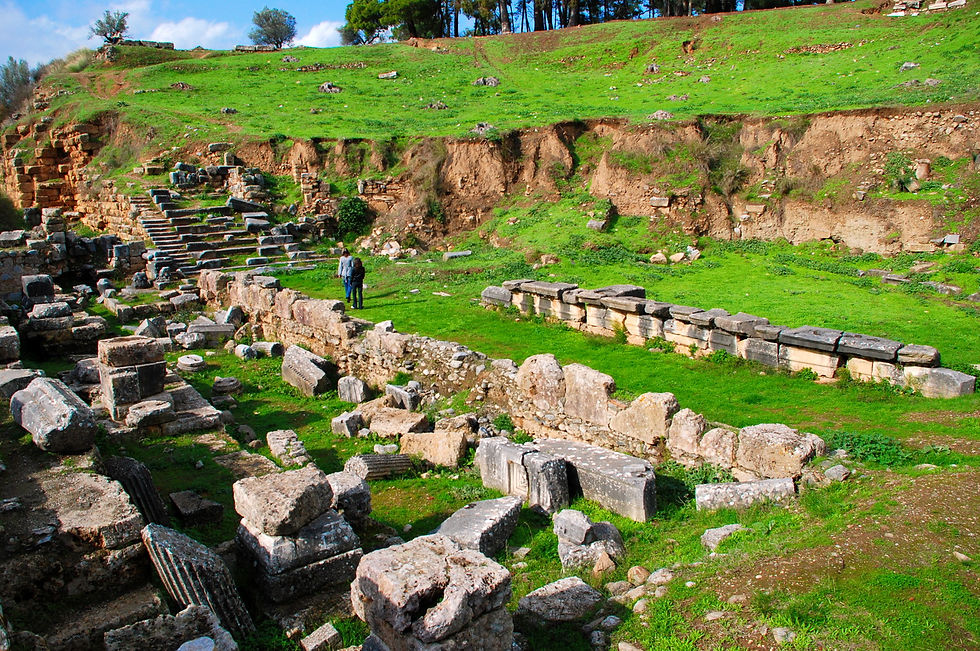
Greece Athens Taxi will take you in the heard of the city but also on the surrounded hills... Acropolis of Sparta is open to visitors and Greece taxi/drivers will take you to visit and view ancient Sparta from different angles.


Until the early 20th century, the chief ancient buildings at Sparta were the theater, of which, however, little showed above ground except portions of the retaining walls the so-called Tomb of Leonidas, a quadrangular building, perhaps a temple, constructed of immense blocks of stone and containing two chambers; the foundation of an ancient bridge over the Eurotas river; the ruins of a circular structure; some remains of late Roman fortifications; several brick buildings and mosaic pavements.
Medieval and modern Sparta
According to Byzantine sources, some parts of the Laconian region remained pagan until well into the 10th century AD. Doric-speaking populations survive today in Tsakonia. In the Middle Ages, the political and cultural center of Laconia shifted to the nearby settlement of Mystras, and Sparta fell further in even local importance. Modern Sparti was re-founded in 1834, by a decree of King Otto of Greece.
Why Greece taxi: Because, we visit Ancient Sparta as travelers, we get as excited as you, we love touring & photography...We love what we do...:) Although we have greatly enjoyed traveling around Greece, checking out places, taking photos and writing our text, as we are sure you can appreciate, it was at great expense and also time consuming. We continue to develop the site updating and adding new information constantly. Therefore we kindly ask any interested party who wishes to copy any part of the site - text or photos - to contact us and make a proposal before doing so. Thank you for your co-operation. Greece Taxi & Minivan Service




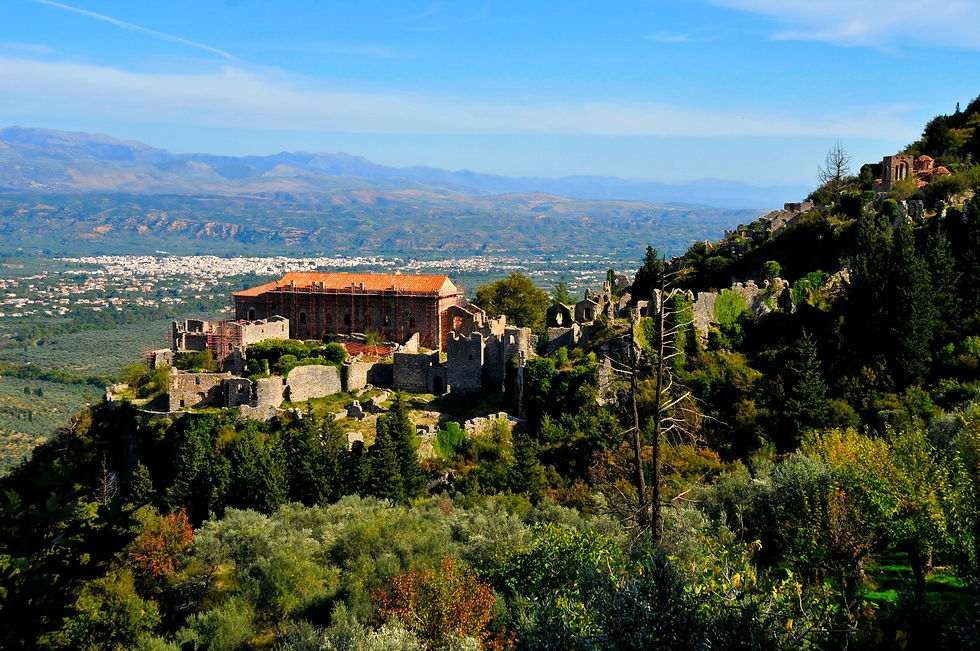
Following the road from Sparta which passes through plane trees, cypresses, olive trees, mulberries and orange trees we reach Mystras. In the distance, mount Taygetos looms proudly. We scan its innumerable peaks, precipitous slopes and deep gorges until our gaze suddenly rests on a hill, detached from the mountain range. On the naturally defended hill of Myzithras in Lacedaimon, the ruler of the Frankish Principate of Achaia Guillaume de Villehardouin built in 1249 a strong medieval castle the "Oriokastro" which was to play an important role in the history of the last centuries of the Byzantine empire.
The last Byzantine emperor, Constantine XI Palaiologos, was despot at Mystras before he came to the throne. Demetrius Palaeologus the last despot of Morea, surrendered the city to the Ottoman emperor Mehmed II in 1460. The Venetians occupied it from 1687 to 1715, but otherwise the Ottomans held it until 1821 and the beginning of the Greek War of Independence. It was abandoned under King Otto for the newly rebuilt town of Sparta.
In 1989 the ruins, including the fortress, palace, churches, and monasteries, were named a UNESCO World Heritage Site.
Greece taxi visits Mystras... a medieval Byzantine town




Daily: Visit Sparta and Mystras (on a day or up to 10 hours) or combined with other sites. Please read our Touring/Info*
Sites & Museums: Summer: daily, 8.00 to 20.00 pm. Winter: 8.00 to 17.00 approx. Last entry 30 min before closing.
Entrance fees: Read TouringInfo
Closed on Holidays: January 1st. , March 25th, May 1st, Easter Sunday, Christmas Day and Boxing Day. On Good Friday, the sites are open 12.00 - 17.00.

Highlights of Ancient & Modern Sparta
-
Acropolis Hill
-
Sparta Museum (Monday Closed)
-
Ancient Theater
-
Leonidas Memorial
-
Mount Taygetos
-
Olive oil Museum
-
Mystras Medieval town 5km
-
Modern City - Archaeological Museum - Agora