

Greece Taxi Tours & Transfers - Private Tours in/from Athens /Multiple Day Tours in Greece
Greece Taxi Tours Info Tel:+30 210 9768557(8.00AM -22.00PM)+30 698 6688 996 greecetaxi@greecetaxi.gr

Visit Cape Sounion
and Poseidon Temple.
Cape Sounion & Poseidon Temple, private tour to enjoy, admire one of the best sunset panoramic views. Half/ full day, evening tour. Greece Taxi Minivan Service


Attractive beaches surround Athens, being in the center of the Attica Peninsula. This region has developed into a popular holiday destination. There is a selection of lively resort towns, all less than a one-hour drive away from Athens, making Attica the ideal choice for a combined seaside-city vacation. The Apollo Coast starts right in Athens. It begins in Piraeus, the port of Athens, and extends to the southern tip of the Attica Peninsula at Cape Sounion.
Cape Sounion is dominated by the spectacular Temple of Poseidon overlooking the Aegean sea. On the rocky peninsula that projects into the sea at the south-east tip of Attica, the Athenians built sanctuaries to their two most important deities: Poseidon and Athena. The temple of Poseidon, was built on the summit of the rock rises 60m above the sea, and is surrounded by stout walls; two temples to Athena Sounias were erected at a lower level.

Cape Sounion and Poseidon temple Tour. Greece Taxi Minivan


Cape sounion Poseidon Temple: According to Greek Mythology, Cape Sounion is the spot where Aegeus, King of Athens, leapt to his death off the cliff, thus giving his name to the Aegean Sea. The story goes that Aegeus, anxiously looking out from Sounion, despaired when he saw a black sail on his son Theseus's ship, returning from Crete. This led him to believe that his son had been killed in his contest with the dreaded Minotaur, a monster that was half man and half bull. The Minotaur was confined by its owner, King Minos of Crete, in a specially designed labyrinth. Every year, according to the myth, the Athenians were forced to send seven men and seven women to Minos as tribute. These youths were placed in the labyrinth to be devoured by the Minotaur. Theseus had volunteered to go with the third tribute and attempt to slay the beast. He had agreed with his father that if he survived the contest, he would hoist a white sail on his return. In fact, Theseus had successfully overcome and slain the Minotaur, but tragically had simply forgotten about the white sail
Ancient Greeks believed that Sounio was the house of Poseidon, the God of the Sea. Today the Greeks still come and pay homepage to the divine nature of the Cape (Akrotirion) words cannot describe it . Standing on ground consecrated in times long gone by are the remains of the sanctuary dedicated to Poseidon on Cape Sounion. The temple, which was built of marble between 444 and 440 BC. on the orders of Pericles probably the work of the same architect who built the Theseum in Athens. It was a Doric building with a peristyle replacing an earlier 6c BC. which had been destroyed in the second Persian War by the Persians in 480 B.C. Abandoned for many years to the ravages of the weather and treasure seekers, it was restored in the 19th C, several columns have been re-erected. It is no exaggeration to state that some of the most beautiful sunsets in the world can be seen from this most striking spot .


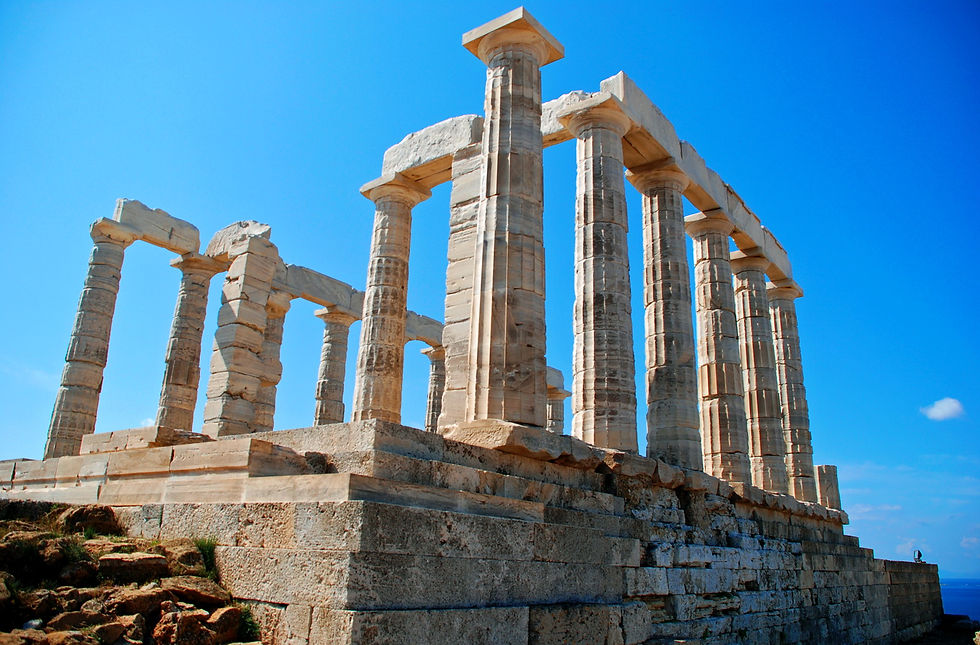


Cape Sounion Sunset Tour: Another beautiful view of the light and slender columns of the Temple of Poseidon. The 16 columns of the peristyle, all that remain of the 34 originals which supported the architrave, seem very tall although they are only 6.10m/20ft high.
The Temple is surrounded on the three sides by the Sea and offers you breathtaking view of the endless blue of the Aegean sea. Before entering the Archaeological site you can enjoy a cup of coffee or refreshment at the local cafe. Now the sun has touched the water offering you one of the most romantic and beautiful sunset you ever experienced.
In the bay below were boat -houses, of which some remains can be seen. At the west end of the headland are preserved two ship sheds protected by the fortification wall. They consist of two slipways, deep, long cuttings in the rock, on which rested a wooden structure that protected the bottom of the ships when they were dragged out of the sea. The ships were kept here for use in case of emergency.


Signatures on the column, including Lord Byron's. The inscribed name of the famous Romantic poet George Lord Byron, carved into the base of one of the columns of the Temple of Poseidon, possibly dates from his first visit to Greece, on his Grand Tour of Europe before he acquired fame. Byron spent several months in 1810–11 in Athens, including two documented visits to Sounion. There is, however, no direct evidence that the inscription was made by Byron himself. Byron mentions Sounion in his poem Isles of Greece:
Why Greece taxi: Because, we visit Cape Sounion as travelers, we get as excited as you, we love touring & photography...We love what we do...:) Although we have greatly enjoyed traveling around Greece, checking out places, taking photos and writing our text, as we are sure you can appreciate, it was at great expense and also time consuming. We continue to develop the site updating and adding new information constantly. Therefore we kindly ask any interested party who wishes to copy any part of the site - text or photos - to contact us and make a proposal before doing so. Thank you for your co-operation. Greece Taxi & Minivan Service
Cape Sounion/ Poseidon / Daily: Book this tour (half day up 5 or one day tour up to 8 hours)
On Summer weekends when there is a lot of traffic five hours is not really enough if you want to swim and have a relaxing lunch, therefore we recommend 8 hours, if you have the time...
Site is closed on Holidays :January 1st. March 25th, May 1st, Easter Sunday, Christmas Day and Boxing Day. On Good Friday, the sites are open 12.00 - 17.00.

CAPE SOUNION HIGHLIGHTS
-
Temple of Poseidon
-
Splendid view of the Saronic Gulf
-
Sunset photo time
-
Swimming/Lunch by the sea.
-
Port of Lavrion