

Greece Taxi Tours & Transfers - Private Tours in/from Athens /Multiple Day Tours in Greece
Greece Taxi Tours Info Tel:+30 210 9768557(8.00AM -22.00PM)+30 698 6688 996 greecetaxi@greecetaxi.gr

DELPHI TOUR
APOLLO ORACLE-NAVEL OF THE WORLD
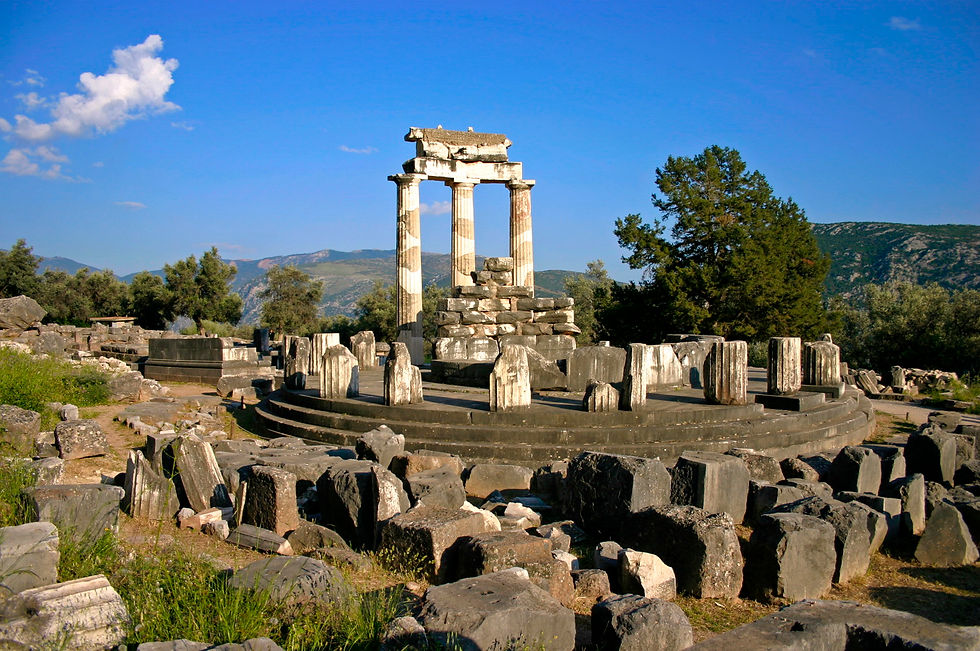
Delphi Tour includes: Apollo Oracle, Athena Tholos, Korykion Andron, Mount Parnassos. The Greeks called Delphi the omphalos or Navel of the world.. Delfoi/ Greece taxi tour


The site of Delphi is located in upper central Greece, on multiple plateau/terraces along the slope of Mount Parnassus, and includes the Sanctuary of Apollo, the site of the ancient Oracle.
In myths dating to the classical period of Ancient Greece (510-323 BC), the site of Delphi was believed to be determined by Zeus when he sought to find the center of his "Grandmother Earth" (Ge, Gaea, or Gaia). He sent two eagles flying from the eastern and western extremities, and the path of the eagles crossed over Delphi where the omphalos, or navel of Gaia was found.
Earlier myths include traditions that Pythia, or the Delphic oracle, already was the site of an important oracle in the pre-classical Greek world (as early as 1400 BC) and, rededicated from about 800 BC, when it served as the major site during classical times for the worship of the god Apollo.
Delphi stands high on the slopes of Mount Parnassus, in the heart of Phocis at the crossroads of important routes of the ancient world. It is one of the most famous cult sites in Greece, renowned throughout the ancient Greek world and beyond as the sanctuary of Apollo and the seat of his oracle. It was at the end of the Mycenaean period that Apollo, an Olympian God and guarantor of universal harmony, is supposed to have overcome the old underworld deities. A hymn attributed to Homer tells how, after his birth on Delos , Zeus' son came to Delphi, killed the snake Python with his bow and arrow and in accordance with divine law, he went into exile for eight years to atone for the killing of the snake and on his return he took his place, becoming the god Python who gave oracles through the intermediary of the Pythia. A festival comprising of dramatic and lyric contests was held in the sanctuary theater, and the stadium was home not only to the athletic games, but also to musical events.
Despite the rise of Christianity across the Roman Empire, the oracle remained a religious center throughout the 4th century, and the Pythian Games continued to be held at least until 424 AD however, the decline continued. The attempt of the emperor Julian to revive polytheism did not survive his reign. The site was abandoned in the 6th or 7th centuries, although a single bishop of Delphi is attested in an episcopal list of the late 8th/early 9th centuries.

Oracle of Apollo at Delphi Pythia, who spoke on behalf of the gods
Early in the 6c BC, when the Athenians were the major power in central Greece, they reorganized the Pythian Games at Delphi at which sports and poetic contests were held. This was the heyday of Delphi as a Pan-Hellenic sanctuary attracting pilgrims from all over the Greek world, from Spain to the Black Sea. The sanctuary was maintained by the dues paid by those who consulted the oracle and enriched by offerings from both Greeks and barbarians. The gods still watch over Delphi Silent and invisible or in the form of strange, anthropomorphic clouds.


Why Greece taxi: Because, we visit Delphi, Apollo oracle and Temple of Athena Pronaia as travelers, we get as excited as you, we love Travelling & photography...We love what we do...:) Although we have greatly enjoyed traveling around Greece, checking out places, taking photos and writing our text, as we are sure you can appreciate, it was at great expense and also time consuming. We continue to develop the site updating and adding new information constantly. Therefore we kindly ask any interested party who wishes to copy any part of the site - text or photos - to contact us and make a proposal before doing so. Thank you for your co-operation. Greece Taxi & Minivan Service.


To the south-east of the sanctuary of Apollo is the sanctuary of Athena Pronaia. The most important buildings in it are the goddess's two temples, dating from the 5th and 4th c. and the Tholos, which was built about 380BC. A jewel of the first half of 380 B.C. the famous Tholos of Delphi is a work by Theodorus of Phocaea in Athena Pronaia’s sanctuary. View our virtual tour http://youtube/O5ZSCU1lwN4?hd=1




The Delphi Archaeological Museum
is at the foot of the main archaeological complex, on the east side of the village, and on the north side of the main road. The museum houses an impressive collection associated with ancient Delphi, including the earliest known notation of a melody, the famous Charioteer, golden treasures discovered beneath the Sacred Way, and fragments of reliefs from the Siphnian Treasury. Immediately adjacent to the exit (and overlooked by most tour guides) is the inscription that mentions the Roman proconsul Gallio.
Entries to the museum and to the main complex are separate and chargeable, and a reduced rate ticket gets entry to both. There is a small cafe, and a post office by the museum.
Few statues have ever acquired so great and well deserved a fame as the bronze charioteer which originally belonged to a larger group which represented a chariot with four horses from which only small fragments survived. Its height is 1.8 m and is made up from six separate cast parts. Dedicated by Polyzalos, tyrant of the Sicilian city of Gela, for his victory in the race at the Pythian Games, probably in 474 BC. it is admired for its superb art.


Archaeologists are good at recovering things left behind by the past, such as buildings, incense altars, tools and relief carvings. What they are not so good at recovering are the ideas, feelings and emotions of sentient ancient beings. It's one thing to examine a temple's holy of holies, it's another thing to understand what went on there and what people experienced. Sometimes, however, there's an exception to the rule. Numerous classical authors report that natural phenomena played an essential part in one of their most sacred religious rituals: the oracle at Delphi. According to the geographer Strabo (c. 64 B.C. - 25 A.D.), for example, "the seat of the oracle is a cavern hollowed down in the depths...from which arises pneuma [breath, vapor, gas] that inspires a divine state of possession". Over the past five years, a team of researchers - a geologist, an archaeologist, a chemist and a toxicologist - has put that claim to the test, making it much more likely that we will actually understand what happened at Delphi. When ancient Greeks and Romans had to make decisions, they consulted the gods by drawing lots, casting dice, interpreting dreams and analyzing such signs as sneezes, thunderbolts and flying birds. But for matters of the utmost importance, they sought to hear the words of the gods in the mouths of oracles. Paradoxically, in male dominated classical Greece the most influential voice, the Delphic oracle, belonged to a woman. The oracular temple was perched on the south slope of Mount Parnassus, surrounded by high cliffs, about 75 miles west of Athens. Getting to Delphi required either a long trek across the mountains or a sea voyage to the north shore of the Gulf of Corinth. However difficult the journey, thousands of visitors sought guidance from the holy woman, called the *Pythia, who spoke on behalf of the gods. *Pythias were virgins who dedicated their lives to prophesying on behalf of the god Apollo. The first Pythia is said to have been the goddess Themis. According to sources, the Pythia was inspired by mysterious vapors, though these accounts have been largely ignored by modern researchers. Now, however, a team of archaeologists and geologists have proved that the Temple of Apollo sat directly above fault lines that likely released intoxicating carbon based gases into the adytum. Was this the oracle's secret?

Oracle of Apollo at Delphi. Pythia, who spoke on behalf of the gods... Pythia: Was she Really Stoned? Jelle Zeilinga De Boer & John R. Hale
The Pythia dealt less in visions of the future than in right choices: where to locate a new colony, when to attack an enemy, how to lift a curse, whom to choose as leader, what offering to make to which god. No kingdom, city or private person could afford to make critical decisions without consulting the Pythia. The Pythia sat in accessed inner sanctum called the adytum, a Greek word meaning "not to be entered". Standing outside the adytum, visitors would ask their questions and await the response. Unlike itinerant prophets and omen - interpreters, the Pythia derived her power from the place - she could only prophecy while seated in the adytum within the temple of Apollo. According to the Strabo, the pneuma arose from a small opening (chasm gas) in the adytum: "Over the mouth [of the opening] a high tripod is set. Mounting this, the Pythia inhales the pneuma and then speaks prophecies in verse or in the prose. The latter are versified by poets on duty in the temple". Strabo was not the only ancient source to describe the adyton and the intoxicating gas.

The Birth Place of Greek Mythology
Pausanias in his Guide to Greece writes:
On the way from Delphi to the summit of Parnassus, about sixty stades distant from Delphi, there is a bronze image. The ascent to the Corycian cave is easier for an active walker than it is for mules or horses. I mentioned a little earlier in my narrative that this cave was named after a nymph called Corycia, and of all the caves I have ever seen this seemed to me the best worth seeing.... But the Corycian cave exceeds in size those I have mentioned, and it is possible to make one's way through the greater part of it even without lights. The roof stands at a sufficient height from the floor, and water, rising in part from springs but still more dripping from the roof, has made clearly visible the marks of drops on the floor throughout the cave. The dwellers around Parnassus believe it to be sacred to the Corycian nymphs, and especially to Pan.

The Korykion Andron / Corycian Cave is located on the slopes of Mount Parnassus, in Greece. In the mythology of the area, it is named after the nymph Corycia; however, its name etymologically derives from korykos, "knapsack". A modern name for the cave in some references is Sarantavli, meaning "forty rooms". This cave was sacred to the Corycian Nymphs and the Muses, and a place of worship for Pan. Strabo, in his Geography, writes: The whole of Parnassos Mountain in Phokis is esteemed as sacred to Apollo, since it has caves and other places that are held in honor and deemed holy. Of these the best known and most beautiful is Korykion, a cave of the Nymphai bearing the same name as that in Kilikia in Asia Minor.
An excavation by French archaeologists in 1969 produced a plethora of objects of antiquity including a rare Neolithic male figurine, Mycenaean shards, bone flutes, iron and bronze rings, miniature bronze statues, 50,000 terracotta figurines from the classical period and 24,000 astragaloi, or "knucklebones" (used for astragalomancy, or "prophecy by knucklebones"). Traditionally the cave has been a place of refuge for the surrounding population during foreign invasions e.g. from the Persians (Herodotus, 8.36) in the 5th century BC, the Turks during the Greek War of Independence, and from the Germans in 1943. King Otto and Queen Amalia made a royal tour with 100 torchbearers to view the two chambers of the cavern which is enormous at 100 m long, 60 m wide and 30 m high.

KORYKION ANDRO / CORYCIAN CAVE
The Corycian Cave is located on the slopes of Mount Parnassus, in Greece. In the mythology of the area, it is named after the nymph Corycia... however, its name etymologically derives from korykos, "knapsack".


Daily: Visit Delphi (one day tour up to 9 hours)
Delphi Sites & Museums: Summer: daily, 8.00 to 20.00. Winter: 8.00 to 17.00 Last entry 30 min before closing.
Entrance fee to Site & Museum 12 Euro.
Closed on Holidays: January 1st. , March 25th, May 1st, Easter Sunday, Christmas Day and Boxing Day. On Good Friday, the sites are open 12.00 - 17.00.

Highlights of Delphi
-
ApolloTemple
-
New Museum
-
Athenian Treasury
-
Stadium / Theater / Gymasion
-
Athena Tholos
-
Crystalia Spring
-
Korykion Andron